Most first-time founders in India pick a business structure based on what sounds simpler, not what actually fits their five-year plan. OPC registration looks attractive because it needs just one person, one director, and minimal paperwork. But that simplicity comes with a ceiling, an OPC cannot bring in co-founders, cannot issue ESOPs, cannot raise venture capital, and is legally restricted from certain business activities altogether.
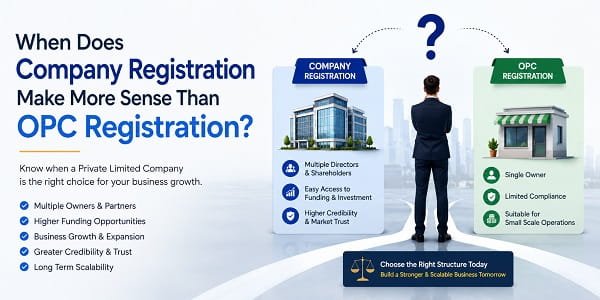
Company registration, meaning incorporation as a Private Limited Company under the Companies Act, 2013, solves exactly these limitations. It allows multiple shareholders, external investment, employee stock options, and far greater credibility with banks, vendors, and government tenders, but it also comes with higher compliance obligations.
What Is OPC Registration?
- OPC Registration refers to the incorporation of a company having one member and one director, providing a limited liability status and separate legal entity to a sole proprietor.
- It is introduced under Section 2(62) of the Companies Act, 2013 where one individual can run a company without requiring any partner but get the benefits of corporations like limited liability status and perpetual succession through nominee.
- Eligibility of OPC (as amended by Companies (Amendment) Act, 2020 & Companies (Incorporation) Second Amendment Rules, 2021):
- Only an Indian citizen who is a natural person can be a member of an OPC
- The individual should be a resident of India, i.e., a person having remained in India for at least 120 days in the immediately preceding financial year (reduced from previous 182 days requirement)
- Now NRI are eligible for OPC registration post 2021 amendment where earlier full restriction on NRI membership in OPC existed
- A nominee is required to appoint at the time of registration and acts in case of death or insolvency of the sole member
- An OPC cannot be incorporated for charitable or non-profit purposes (a Section 8 company is used instead) and cannot carry out Non-Banking Financial Investment (NBFI) activities
Did You Know? An OPC can appoint up to 15 directors even though it can never have more than one shareholder, directorship and ownership are not the same thing under Indian company law.
What Is Company Registration (Private Limited Company)?
Company Registration Private Limited Company is the registration of a company under Section 2(68) of the Companies Act, 2013, where a minimum of two members and two directors are required and have a limited liability according to the amount of share held by the member.
- Private Limited Company (Pvt Ltd) is the most favored business entity in India for startups and growth firms since it allows more than one owner, raises funds externally, and provides scalability in governance.
- Eligibility for Private Limited Company Registration:
- Minimum 2 members, maximum 200 members
- Minimum 2 directors, one of whom is a resident of India
- No minimum capital requirement
- Members may include individuals, companies, and foreign bodies (as per FDI guidelines)
- The process is done through an integrated SPICe+ form in the MCA V3 portal, which includes name reservation, registration of company, DIN, PAN, TAN, GSTIN, EPFO, and ESIC registrations in one go
Company Registration vs OPC Registration: Key Differences
| Feature | Private Limited Company | OPC |
| Minimum Members | 2 shareholders | 1 shareholder |
| Minimum Directors | 2 (1 must be resident) | 1 (can add up to 15) |
| Maximum Shareholders | 200 | 1 (by definition) |
| Foreign Investment (FDI) | Permitted under automatic/approval route | Not permitted directly |
| ESOPs for Employees | Allowed | Not allowed |
| Fundraising from VCs/PE/Angels | Straightforward, equity dilution possible | Not possible without prior conversion |
| Succession | Shares transferable per AoA | Nominee takes over automatically |
| Mandatory Conversion Trigger | Not applicable | None (removed by 2021 amendment) |
| Compliance Burden | Higher (board meetings, AGM, more filings) | Lower (fewer meetings, simpler filings) |
| Credibility with Banks/Investors | High | Moderate |
| Governing Section | Section 2(68), Companies Act 2013 | Section 2(62), Companies Act 2013 |
When Does Company Registration Make More Sense Than OPC?
1. You Require a Co-Founder or Additional Shareholders
A One Person Company is not allowed to have any more than one single person holding the shares. From the very start, if you have even a hint of your business venture involving a co-founder, relative, or business associate, your only viable option is Private Limited Company Registration.
2. You Have Plans to Raise Money
Angel investors, venture capitalists, or private equity companies will not consider investing in your OPC because an OPC cannot raise additional shares from external sources. A Private Limited Company finds this a breeze to do.
3. You Have ESOPs in Mind
ESOPs are used by many startups for retaining their initial workforce. OPCs cannot have ESOPs because in order to provide them, you need multiple shareholders, and a Private Limited Company allows you to do just that.
4. Foreign Investments or Foreign Presence Required
Foreign Direct Investments are not permitted in OPCs. If your business strategy revolves around having foreign investments or foreign parent companies, your first step would be registration of Private Limited Company.
5. Your Turnover or Capital Is Scaling Up Quickly Already
Even though the Companies (Incorporation) Second Amendment Rules, 2021 has changed the previous compulsory trigger (₹50 lakh paid-up capital / ₹2 crore average turnover), it is usually simpler for those companies which are approaching such levels to just incorporate as a Private Limited Company right away.
6. You Need More Credibility from Banks, Suppliers, and Government Tendering Agencies
Many larger suppliers, government agencies, PSUs and banks prefer doing business with Private Limited Companies because of multi-director governance and higher disclosure standards.
7. You Are Developing a Business That Will Outlive the Involvement of a Single Person
In the case of an OPC, the entire continuity hinges on the nomination process. The Private Limited Company structure, with its board and multiple shareholders, is considered more enduring.
When Does OPC Still Make Sense?
OPC isn’t outdated, but rather applicable to particular scenarios:
- Independent consultants and freelancers who need limited liability without extra regulation of a board of multiple members
- Founders who don’t see the immediate need for raising funds from external investors
- Organizations that prefer annual expenses on compliance to be less than those for a Private Limited Company
- Entrepreneurs who need time to experiment with their business models
Documents Required for Private Limited Company vs OPC Registration
| Document | Private Limited Company | One Person Company (OPC) |
| PAN Card of all proposed directors and shareholders | Required | Required |
| Aadhaar Card of all proposed directors | Required | Required |
| Digital Signature Certificate (DSC) | Required for each director | Required for the sole director |
| Passport-size photograph of the proposed director(s) | Required | Required |
| Registered office address proof (utility bill, rent agreement, or ownership document) | Required | Required |
| Nominee’s written consent (Form INC-3) | Not Required | Mandatory |
| No Objection Certificate (NOC) from the property owner (if applicable) | Required | Required |
Registration Process (SPICe+ Form)
- Name Reservation, File Part A of SPICe+ for name approval (2–4 working days)
- Digital Signature Certificate (DSC), Obtain a Class 3 DSC for each proposed director
- Drafting MOA and AOA, Prepare e-MOA and e-AOA defining the company’s objectives and internal rules
- Filing SPICe+ Part B, Submit incorporation details along with AGILE-PRO-S (for GSTIN, EPFO, ESIC, bank account, and profession tax)
- Certificate of Incorporation, Issued by the Registrar of Companies (ROC) along with CIN, PAN, and TAN
- Post-Incorporation Compliance, File Form INC-20A (commencement of business) within 180 days
Fees and Timelines
| Parameter | Private Limited Company | OPC |
| Government Incorporation Fee | Nil for authorised capital up to ₹15 lakh | Nil for authorised capital up to ₹15 lakh |
| Stamp Duty | ₹200–₹12,600 (state-dependent) | ₹200–₹12,600 (state-dependent) |
| DSC Cost | ₹2,000–₹4,000 per director | ₹2,000–₹4,000 (sole director) |
| Professional Fees | ₹5,000–₹15,000+ | ₹4,000–₹12,000+ |
| Total Approximate Cost | ₹10,000–₹25,000 | ₹8,000–₹18,000 |
| Timeline | 7–10 working days | 7–10 working days |
Note: Government fees, stamp duty, and professional charges are revised periodically by the MCA and state governments, always verify current rates before filing.
Common Mistakes Founders Make
- Registering as an OPC purely to save on initial compliance, without planning for future fundraising needs
- Assuming OPC-to-Private-Limited conversion is instant, it typically takes 45–60 days and costs ₹12,000–₹35,000
- Not appointing a valid, consenting nominee at the time of OPC incorporation
- Choosing Private Limited Company registration without a second genuine shareholder, leading to nominee shareholding complications
- Ignoring Form INC-20A filing deadlines after incorporation, risking penalties or strike-off proceedings
OPC to Private Limited Company Conversion: What Changed in 2021
YES. Following the Companies (Incorporation) Second Amendment Rules, 2021 (effective 1 April 2021), an OPC can voluntarily convert into a Private Limited Company after completing two years from incorporation, with no mandatory financial threshold requirement.
Earlier, an OPC was required to convert once its paid-up capital crossed ₹50 lakh or its average annual turnover exceeded ₹2 crore. That mandatory trigger has been removed. Crossing these thresholds now only makes early conversion (before the two-year mark) permissible, it is no longer compulsory.
Conversion is executed through Form INC-6, supported by Form MGT-14 for the special resolution and Form DIR-12 for appointing additional directors, under Section 18 of the Companies Act, 2013 read with Rule 6 of the Companies (Incorporation) Rules, 2014.
Case Study: A single-founder D2C skincare brand incorporated as an OPC in its first year to keep compliance light. Within 18 months, it needed seed funding from an angel investor. Since the OPC structure legally barred issuing new shares to an outside investor, the founder had to complete a full OPC-to-Private-Limited conversion, taking nearly two months, before the funding round could close. Incorporating directly as a Private Limited Company would have avoided this delay entirely.
Latest Development: The MCA V3 portal has streamlined SPICe+ filings by integrating DIN-PAN-Aadhaar validation in real time, reducing incorporation turnaround for both OPCs and Private Limited Companies to roughly 7–10 working days in FY 2026–27.
Conclusion
Choosing between OPC registration and Company registration isn’t about which is “better” in the abstract, it’s about matching the structure to your business trajectory. OPC works well for solo founders who want limited liability with minimal compliance and no immediate plans to raise external capital. But if co-founders, ESOPs, venture funding, foreign investment, or long-term institutional credibility are anywhere on your roadmap, incorporating directly as a Private Limited Company avoids the cost, delay, and compliance disruption of converting later.
Why Choose Zolvit
- Expert lawyers, Chartered Accountants, and Company Secretaries under one roof
- Structure-fit assessment before you file, not after
- Fast processing through the MCA V3 SPICe+ integrated route
- Transparent, affordable pricing with no hidden charges
- End-to-end compliance support, from incorporation to annual filings and future conversions
- Dedicated relationship manager for every registration
FAQs
Q: Can an OPC have more than one shareholder?
A: NO. An OPC is legally restricted to exactly one shareholder under Section 2(62) of the Companies Act, 2013. If you need multiple owners, you must incorporate a Private Limited Company or convert your existing OPC into one through the Form INC-6 process.
Q: Should a startup planning to raise VC funding register as an OPC?
A: NO. Venture capital investors require the ability to receive newly issued shares, which an OPC cannot legally offer to outside parties. Startups planning any external fundraising should register directly as a Private Limited Company to avoid a costly conversion later.
Q: Is a minimum paid-up capital required for either structure?
A: No minimum paid-up capital is required for either a Private Limited Company or an OPC under current rules. Both can be incorporated with any capital amount the founder chooses, making capital requirement a non-factor in the decision.
Q: Can an OPC convert to a Private Limited Company before two years?
A: YES, but only if its paid-up capital exceeds ₹50 lakh or average turnover exceeds ₹2 crore. Otherwise, voluntary conversion is permitted only after completing two years from the date of incorporation, per the 2021 amendment rules.
Q: Are NRIs allowed to register an OPC in India?
A: YES. Following the Companies (Amendment) Act, 2021, NRIs can now incorporate an OPC provided they have resided in India for at least 120 days in the preceding calendar year, a relaxation from the earlier complete restriction on NRI ownership.