Every founder eventually faces a critical early decision Sole proprietorship, partnership, LLP, One Person Company, or private limited company, each option has different implications for liability, taxation, fundraising, and long-term scalability. Get this decision wrong, and it can quietly limit growth, scare away investors, or expose founders to personal financial risk.
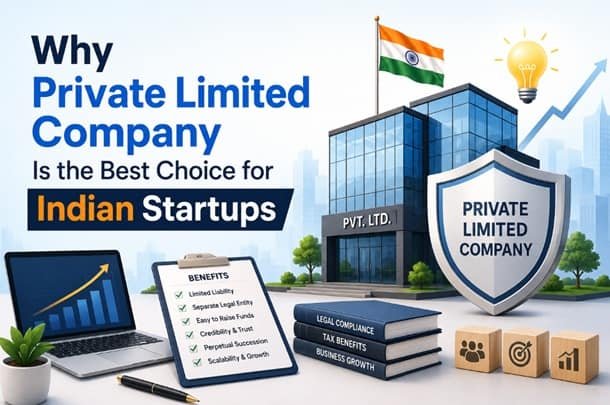
For the vast majority of Indian startups, especially those planning to raise funding, hire a team, or scale beyond a single founder, private limited company registration has emerged as the clear winner. It isn’t just a popular choice; it’s a structural decision backed by legal protection, investor expectations, and market credibility that other business forms simply can’t match.
What Is a Private Limited Company?
A private limited company is a privately held business entity registered under the Companies Act, 2013, offering limited liability protection to its shareholders and a separate legal identity from its owners.
It requires a minimum of two directors and two shareholders, and restricts the transfer of shares to the public, making it distinct from a public limited company. This structure is created through company registration with the Ministry of Corporate Affairs (MCA), resulting in a Certificate of Incorporation and a unique CIN.
Why Do Startups Prefer Private Limited Company Registration?
Startups prefer private limited company registration because it offers limited liability, easier access to funding, stronger credibility, and a structure investors are already familiar with.
1. Limited Liability Protection
Founders’ personal assets remain protected from business debts and liabilities. If the company faces losses or legal claims, shareholders are only liable up to their shareholding, not their personal wealth.
2. Investor and Venture Capital Readiness
Almost all Indian venture capital firms and angel investors require a private limited structure before investing. Structures like sole proprietorships or partnerships are generally not eligible for equity funding, making private limited company registration a prerequisite for most fundraising journeys.
3. Separate Legal Identity
The company can own assets, sign contracts, hire employees, and enter agreements in its own name, independent of the founders. This continuity protects the business even if a founder exits or passes away.
4. Easier Employee Stock Option Plans (ESOPs)
Private limited companies can legally issue ESOPs, a critical tool for attracting and retaining early talent without heavy cash outflow, something sole proprietorships and partnerships cannot offer.
5. Stronger Market and Vendor Credibility
Customers, vendors, and corporate clients generally trust a registered private limited entity more than informal structures, especially for B2B contracts and government tenders.
Did You Know? According to MCA incorporation data trends, private limited companies account for the overwhelming majority of new startup registrations in India each year, far outpacing LLPs, OPCs, and partnerships combined.
Private Limited Company vs Other Business Structures
| Feature | Private Limited Company | LLP | One Person Company (OPC) | Sole Proprietorship |
| Liability | Limited | Limited | Limited | Unlimited |
| Ownership | 2–200 shareholders | 2+ partners | 1 owner | 1 owner |
| Fundraising (VC/Angel) | Easy | Difficult | Not eligible | Not eligible |
| ESOPs | Allowed | Not allowed | Not allowed | Not allowed |
| Compliance burden | Higher | Moderate | Moderate | Low |
| Perpetual succession | Yes | Yes | Yes | No |
| Best suited for | Scalable, funded startups | Professional services | Solo founders (early stage) | Very small, local businesses |
How Private Limited Structure Supports Long-Term Scalability
Unlike simpler structures, a private limited company is built to scale:
- Multiple funding rounds can be accommodated through equity dilution across investors.
- Board structure allows for professional governance as the company grows.
- Perpetual succession ensures the business continues regardless of changes in ownership or management.
- Conversion flexibility, while conversion to a public limited company is possible for large-scale growth, downgrading from Pvt Ltd is rarely needed.
Common Misconceptions About Private Limited Company Registration
- ‘It’s too expensive for early-stage startups.’ In reality, government fees are capital-dependent and often minimal for startups with modest authorised capital.
- ‘Compliance is too complex to manage alone.’ With professional support, annual compliance (ROC filings, audits) is manageable and predictable.
- ‘You need a large team to register.’ A private limited company can be formed with just two directors, who may also be the sole shareholders.
- ‘Registration guarantees funding.’ Registration makes a startup eligible for funding, it doesn’t replace the need for a strong business model and traction.
Eligibility and Documents for Private Limited Company Registration
| Requirement | Details |
| Minimum directors | 2 (at least one Indian resident) |
| Minimum shareholders | 2 |
| Minimum capital | No minimum requirement |
| Documents needed | PAN, Aadhaar/Passport, address proof, photographs, registered office proof |
| Digital Signature Certificate | Required for all directors |
Process Flow for Startup Registration
- Obtain Digital Signature Certificates for all directors
- Reserve company name via SPICe+ Part A
- File SPICe+ Part B with incorporation details, MoA, and AoA
- Receive PAN, TAN, and Certificate of Incorporation together
- Open a company bank account and begin post-registration compliance
Time Taken: Typically 7–10 working days, subject to document accuracy and name approval.
Compliance Checklist for Startups Post-Registration
- File Commencement of Business declaration (INC-20A)
- Appoint a statutory auditor within 30 days
- Maintain statutory registers and minute books
- File annual returns and financial statements with RoC
- Apply for GST registration if turnover thresholds apply
- Set up ESOP framework early, if planning to hire
Case Study
Two co-founders in Pune built a B2B logistics-tech platform, initially operating informally while testing their product. As they approached their first institutional funding round, investors explicitly required a private limited company structure before proceeding. The founders completed private limited company registration within 8 working days, restructured their early agreements into formal shareholder arrangements, and successfully closed a seed round shortly after, a deal that would not have been possible under their previous informal setup.
Conclusion
For Indian startups aiming to raise funding, build credibility, and scale sustainably, private limited company registration remains the most suitable structural choice. It offers limited liability, investor readiness, ESOP flexibility, and long-term governance benefits that other structures simply cannot match. While compliance requirements are slightly higher than simpler structures, the trade-off is well worth it for startups with genuine growth ambitions. Founders should consult legal and compliance experts early to ensure the registration process is smooth and future-ready.
Why Choose Zolvit
- Expert lawyers and company secretaries guiding structure selection
- CA support for startup-specific tax planning
- Fast processing tailored for time-sensitive startup timelines
- Affordable, transparent pricing with startup-friendly packages
- End-to-end compliance support beyond just incorporation
- Dedicated support for fundraising-related documentation
CTA: Build your startup on the right legal foundation. Get your private limited company registration done with Zolvit’s experts today, book a free consultation and get investor-ready from day one.
FAQs
1. Can a startup raise venture capital funding without private limited company registration?.
NO, generally not. Most Indian venture capital firms and angel investors require a private limited company structure before investing, as it allows for equity issuance and formal shareholder agreements.
2. Should solo founders choose a private limited company or OPC?
It depends on growth plans. Solo founders planning to scale, add co-founders, or raise funding should eventually move toward private limited company registration, as OPCs have restrictions on fundraising and conversion.
3. What is the minimum number of people required for private limited company registration?
A private limited company requires a minimum of two directors and two shareholders, who can be the same individuals, along with at least one director who is a resident of India.
4. Does a private limited company need to convert structure as it grows?
NO, not necessarily. A private limited company can accommodate significant growth, multiple funding rounds, and scaling without changing its core structure, unlike simpler business forms.
5. Can ESOPs be issued by an LLP or sole proprietorship?
Employee Stock Option Plans (ESOPs) can only be issued by a private limited company, making it essential for startups planning to attract talent through equity-based compensation.